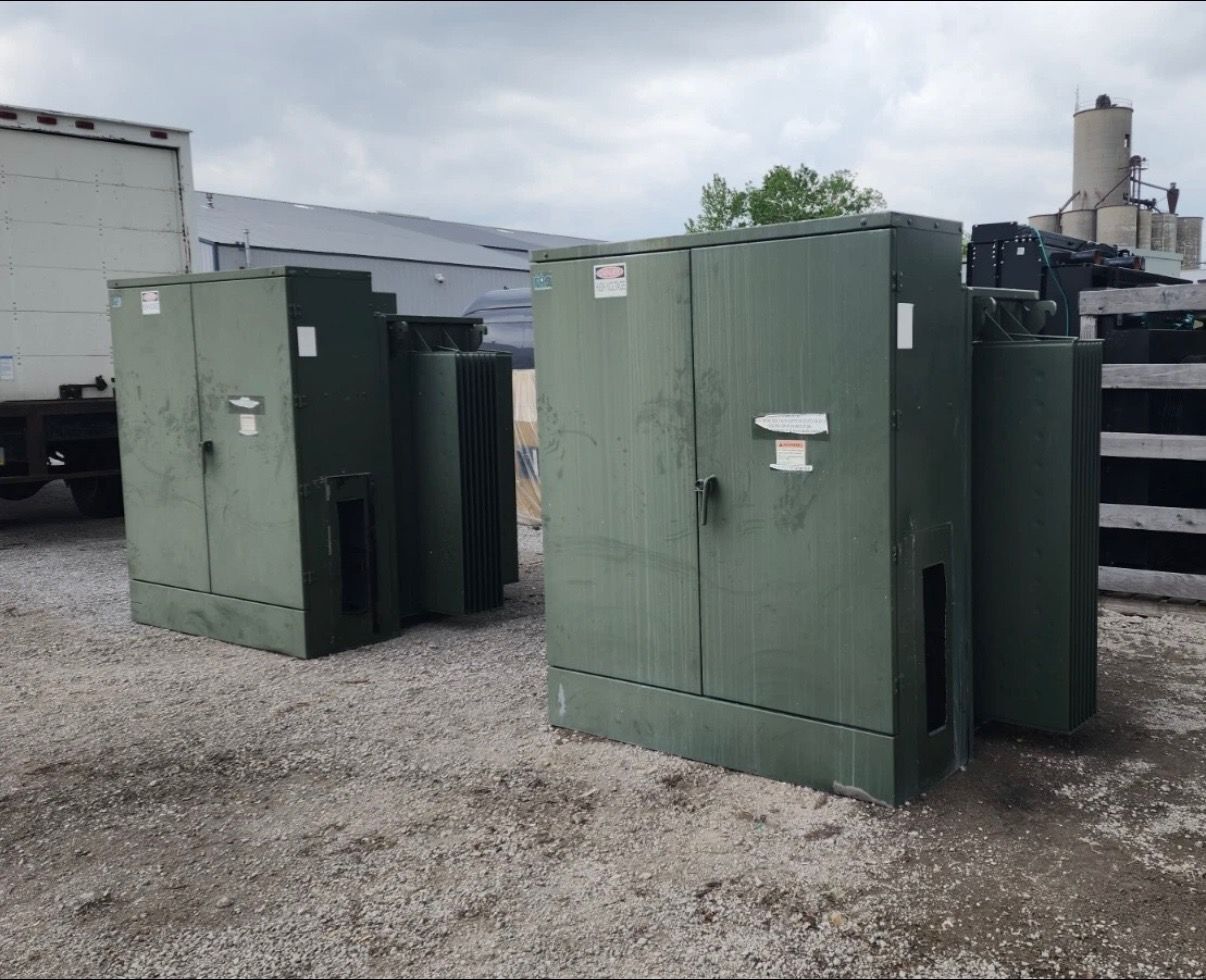
Your Savage equipment
If you are offering a pad-mounted transformer in Savage, start by clarifying whether it belongs to you or your organization; ownership should not be assumed from its location. Send visible nameplate information such as manufacturer, kVA, primary and secondary voltages, phase, and serial number, along with any available fluid or PCB records. Identify unavailable records plainly.
Condition and documentation
The cabinet and base can help describe the unit without opening it. Note visible corrosion, cabinet damage, leaks, or damage around cable compartments, and indicate whether these observations are uncertain. Photos of the exterior, base, and safely accessible nameplate can support an initial review; do not infer fluid contents, contamination, or condition from appearance.
Prepare for a safe transfer
Share where the transformer is stored in Savage, plus approximate weight and dimensions if known and any known loading or access restrictions. Ground-level placement does not establish that removal is straightforward: the pad, surrounding space, and route out should be described as observed. Isolation and verification of de-energization are tasks for appropriately qualified electrical personnel.
Local access in Savage
Savage warehouse and industrial sites may have transformers associated with heavy equipment or building power. A buyer's evaluation benefits from knowing the unit's weight and any attached components.
Check available truck maneuvering room where stored materials or parked trailers narrow the yard.
About pad-mounted transformers
Pad-mounted transformers sit in ground-level enclosures and commonly serve commercial or distribution loads. Buyers assess primary and secondary ratings, phase, enclosure condition, fluid information, and whether the unit is owned by the seller rather than a utility. Corrosion at the cabinet base or damage around cable compartments can affect value and removal planning.
Share the nameplate, cabinet and base photographs, ownership information, and any available fluid or PCB documentation.
Once qualified personnel isolate and verify de-energization, use suitable lifting provisions and protect the tank and cable compartments while moving the unit from its pad.