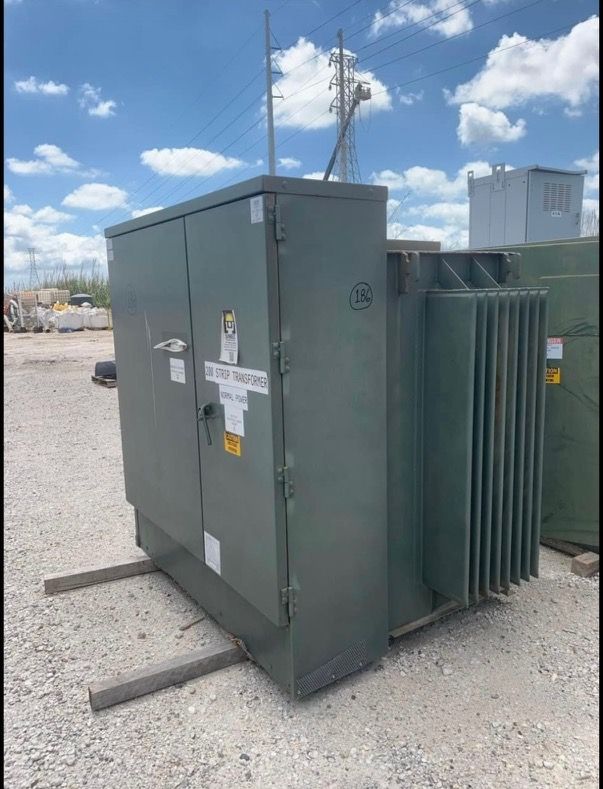
Your Owatonna equipment
A seller in Owatonna can help identify a pole-mounted distribution transformer by sharing its nameplate fields, especially manufacturer, kVA, primary and secondary voltage, phase, serial number, and frequency if shown. Note whether the unit is single-phase or three-phase only when the available information supports that description, and identify any mounting hardware included in the offer.
Condition and documentation
Report what is actually known about the tank, bushings, brackets, corrosion, leaks, and prior faults; if history or fluid details are unavailable, make that clear. Existing service or fluid records may help inform review. Take exterior and nameplate photos only from a safely accessible position—never climb, approach exposed live parts, or handle the unit to obtain images.
Prepare for a safe transfer
For a possible Owatonna-area collection, describe the actual pole or storage location, approximate weight and dimensions if available, and access for lifting and transport. Mention nearby overhead-line constraints or restricted loading access if known. Qualified electrical personnel must isolate and verify de-energization, and trained personnel must plan lowering and movement with suitable equipment.
Local access in Owatonna
Owatonna manufacturing and distribution facilities may have transformers serving motors and building systems. Owners can provide a list of related equipment if several units are being retired together.
Confirm the pickup sequence and available laydown space when multiple pieces are stored in the same plant area.
About pole-mounted distribution transformers
Pole-mounted distribution transformers are typically compact units used to change distribution voltage for local loads. A buyer may distinguish single-phase from three-phase equipment and review voltage, kVA, mounting hardware, tank condition, and fluid history. Confirming ownership and whether bushings or brackets are damaged helps establish what is being offered.
Provide a readable nameplate, photographs of the tank and bushings, and any available records identifying the insulating fluid or PCB status.
Have qualified personnel isolate and verify de-energization before trained riggers lower the unit with suitable equipment while keeping clear of overhead lines.