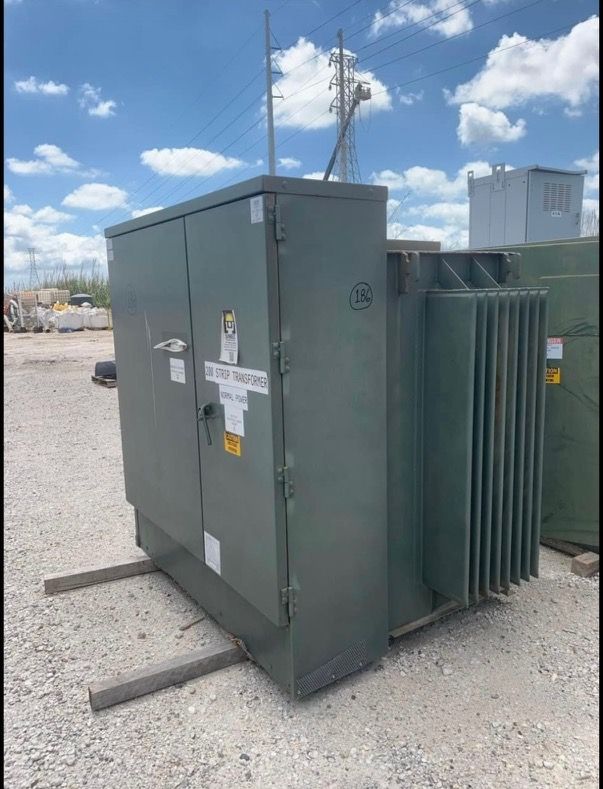
Your Farmington equipment
A seller in Farmington can help identify a surplus pad-mounted transformer by sharing available nameplate details: maker, serial number, kVA, primary and secondary voltages, and phase. Exterior photos of the cabinet, base, and visible cable-compartment areas can clarify condition without opening the enclosure; include ownership information if readily available.
Condition and documentation
Report visible cabinet dents, rust or corrosion near the base, leaks, damaged doors, or other known problems, and distinguish observations from unknowns. Fluid details or records should be shared only when already available; cabinet style alone does not establish fluid condition or environmental status. Do not touch, operate, or disconnect equipment to gather information.
Prepare for a safe transfer
Pickup planning depends on the actual Farmington location and route from the unit to a loading point. Share approximate dimensions and weight if known, whether it remains on a pad or has been staged, and any gate, clearance, surface, or loading constraints. Qualified electrical personnel must handle isolation and verify de-energization before removal.
Local access in Farmington
Farmington businesses and service properties may have equipment serving workshops, storage buildings, or larger commercial spaces. Owners can identify whether a unit is indoors, outdoors, or already staged for loading.
Determine whether a yard surface can support lifting equipment after rain or snowmelt.
About pad-mounted transformers
Pad-mounted transformers sit in ground-level enclosures and commonly serve commercial or distribution loads. Buyers assess primary and secondary ratings, phase, enclosure condition, fluid information, and whether the unit is owned by the seller rather than a utility. Corrosion at the cabinet base or damage around cable compartments can affect value and removal planning.
Share the nameplate, cabinet and base photographs, ownership information, and any available fluid or PCB documentation.
Once qualified personnel isolate and verify de-energization, use suitable lifting provisions and protect the tank and cable compartments while moving the unit from its pad.