Your St. Louis Park equipment
For a pole-mounted distribution transformer offered from St. Louis Park, useful starting details include manufacturer, serial number, kVA, primary and secondary voltages, and whether the nameplate identifies single-phase or three-phase service. Provide an external nameplate photo only if it is safely accessible, and state which information is missing rather than estimating ratings.
Condition and documentation
Describe visible tank corrosion, dents, leakage, bushing damage, and the presence or absence of mounting brackets as observed from a safe position. Include available service or fluid records, but do not infer fluid type or condition from the unit’s appearance. Clarify ownership if known, since equipment located on a pole may not belong to the property owner.
Prepare for a safe transfer
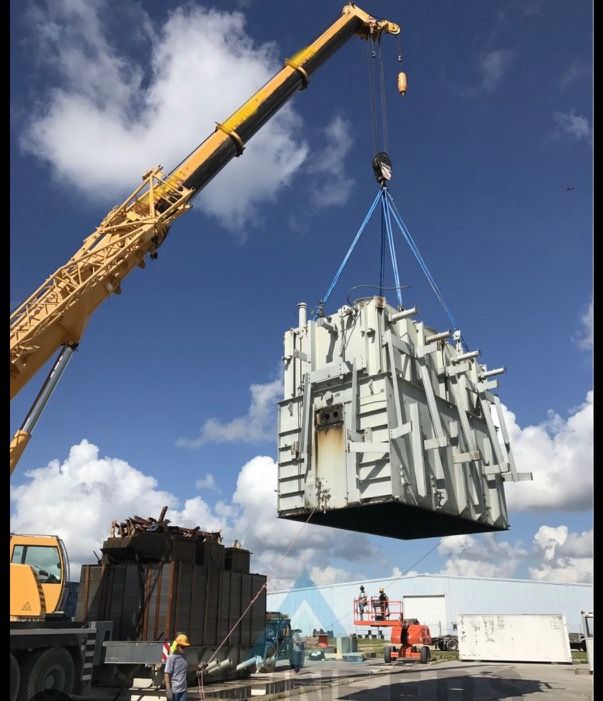
Pickup coordination depends on the actual St. Louis Park location, pole or storage position, access for suitable lifting equipment, and known weight and dimensions. Share those details only when available, including any overhead-line or site constraints already identified. Qualified electrical personnel must isolate and verify de-energization; trained personnel should plan lowering and handling safely.
Local access in St. Louis Park
St. Louis Park has commercial and multifamily properties where electrical rooms may contain older dry-type equipment. A major building renovation can leave a retired unit in a constrained interior space.
Measure hallways, elevator doors, and floor protection needs before scheduling an interior removal.
About pole-mounted distribution transformers
Pole-mounted distribution transformers are typically compact units used to change distribution voltage for local loads. A buyer may distinguish single-phase from three-phase equipment and review voltage, kVA, mounting hardware, tank condition, and fluid history. Confirming ownership and whether bushings or brackets are damaged helps establish what is being offered.
Provide a readable nameplate, photographs of the tank and bushings, and any available records identifying the insulating fluid or PCB status.
Have qualified personnel isolate and verify de-energization before trained riggers lower the unit with suitable equipment while keeping clear of overhead lines.