Your Maple Grove equipment
A pole-mounted unit being offered from a Maple Grove site is easier to identify when you can share its manufacturer, serial number, kVA, primary and secondary voltages, and whether the nameplate indicates single- or three-phase operation. Provide only existing records or a nameplate photo obtainable safely from the ground; never climb or approach overhead conductors for a closer view.
Condition and documentation
Report visible tank corrosion, dents, leakage, damaged bushings, or missing mounting hardware, along with any known service history or failure. If insulating-fluid details or PCB documentation are not available, make that clear rather than guessing. Ownership should also be clarified, since pole-mounted equipment may not belong to the property owner.
Prepare for a safe transfer
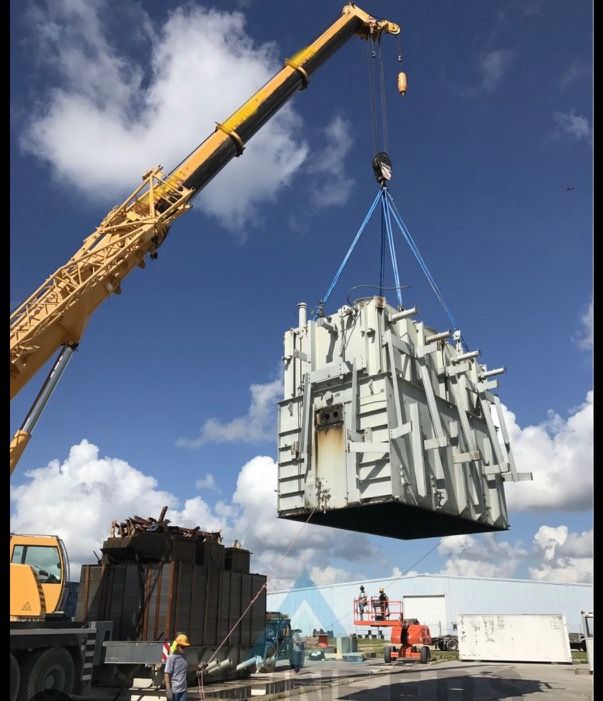
For Maple Grove pickup planning, give the pole or storage location, approximate unit weight and dimensions if known, and practical access information for the site. Note overhead-line presence, restricted vehicle access, or other lifting constraints when known. Qualified electrical personnel must isolate and verify de-energization; trained personnel determine safe removal and handling.
Local access in Maple Grove
Maple Grove office parks and commercial properties may use equipment ranging from small dry-type transformers to larger outdoor units. A redevelopment project can make existing equipment available for a buyer to assess.
Confirm whether a crane or truck can reach the pad without crossing landscaped areas or underground utilities.
About pole-mounted distribution transformers
Pole-mounted distribution transformers are typically compact units used to change distribution voltage for local loads. A buyer may distinguish single-phase from three-phase equipment and review voltage, kVA, mounting hardware, tank condition, and fluid history. Confirming ownership and whether bushings or brackets are damaged helps establish what is being offered.
Provide a readable nameplate, photographs of the tank and bushings, and any available records identifying the insulating fluid or PCB status.
Have qualified personnel isolate and verify de-energization before trained riggers lower the unit with suitable equipment while keeping clear of overhead lines.